

Diane Poole Heller’s final live training on sexual trauma and intimacy
Reclaiming Connection
A Path Beyond Sexual Shame and Disconnection
Help clients find more choice, voice, and connection in their intimate lives. Deepen your work with sexual trauma, shame, and intimacy through an attachment and somatic perspective.
- Our first session starts Tuesday, November 10, 2026
Enrollment Open Now!
6 Training Sessions
$77
Monthly
Recordings Included
Resources included
Understanding How Attachment and Trauma Shape Sexuality, Boundaries, and Intimacy

When a client wants closeness and still pulls away
A client wants intimacy, yet feels far away from their body when someone gets close. Another knows they have the right to say no, but struggles to recognize or express a boundary. Someone else loves their partner and wonders why desire seems easier at a distance.
These concerns may emerge in work focused on trauma, attachment, or relationships.
Sexuality may never have been named as the presenting concern, yet it becomes part of the work in front of you.
These conversations can challenge even experienced clinicians.
How do I open the conversation? What do I attend to when shame or dissociation appears? How do I help a client explore an experience without moving faster than they can tolerate?
Even with substantial training in attachment and trauma, struggles around sex and intimacy can complicate the conversation. This series gives you space to study the intersection of these issues through teaching, clinical demonstrations, and direct discussion with Diane.



A fuller understanding of sexuality and intimacy
Sexuality develops within a relational history. Family and cultural messages, early experiences of care, and respect for a child’s boundaries can all influence how a person comes to experience their body and relate to others.
An attachment and developmental perspective can help you connect present concerns with that larger story. Reclaiming Connection follows the work from understanding sexual self-image and trauma toward supporting agency, embodied consent, pleasure, and intimacy.
Why this work matters in clinical practice
CDC data put lifetime exposure to contact sexual violence at nearly half of U.S. women and more than one-sixth of U.S. men.
For clinicians, these figures underscore the importance of being prepared when sexual trauma becomes part of a client’s story.
How do you approach a conversation about intimacy when shame makes it difficult to speak? How do you support someone who struggles to recognize or express a boundary? How do you explore closeness without moving faster than a client feels ready to go?
These are central questions in Reclaiming Connection. Across six months, Diane will explore sexual development, trauma, embodied boundaries, and intimacy—helping you build a clearer framework for understanding your clients’ experiences and supporting their work toward greater agency and connection.
Develop skills for the conversations that matter
- Hear the developmental story. Recognize how early relationships and messages about the body can shape sexual self-image and what clients feel able to express.
- Approach shame with greater understanding. Explore the confusion that can arise when affection, pleasure, fear, and danger occur together, with attention to pacing and misplaced responsibility.
- Recognize protective responses. Study helplessness, freeze, and dissociation in the context of sexual trauma, and explore how somatic work can support agency.
- Support embodied consent and boundaries. Help clients notice desire, reluctance, and discomfort, then explore ways to trust those signals and express a boundary.
- Connect emotional intimacy and desire. Consider why closeness can bring sexual inhibition for some clients, and study ways to support greater integration.
- Make room for pleasure and aliveness. Explore how to help clients reconnect with curiosity, attraction, and pleasure at a pace they can tolerate.


The next 6-month topic in our annual membership series:
Reclaiming Connection
A Path Beyond Sexual Shame and Disconnection


Join Dr. Diane Poole Heller for her final live training on sexual trauma and intimacy
A six-month exploration of the experiences that shape sexuality—and the clinical work of helping clients reclaim agency, boundaries, and connection.
- Enrollment for the Therapy Mastermind Circle™ is now open until November 9, 2026
Learn directly from leading experts in trauma training!

All for only
(Membership includes access to new topics every 6 months!)
- Six LIVE, two-hour Monthly Training Sessions with Diane Poole Heller, PhD
- Recorded Clinical Demonstrations with Debriefs and with live Q&A
- Private Course Portal with Downloadable Access to Video, Audio, Transcripts and Handouts
- Community discussion, breakout groups, and monthly prompts for practicing what you learn between sessions
- No-Risk 100% Money-Back Guarantee
Our first live call is on November 10, 2026!
Can’t attend live? All training is recorded and available in your learning portal.
**This is an annual membership––with new topics introduced every six months to support your learning.

You’re Protected by our 100% Satisfaction Guarantee
We’re confident this program will be a valuable investment in your education and clinical practice.
Try the Therapy Mastermind Circle membership 100% risk-free! You have 30 days from the start of the first class to contact our Customer Support Team for a full refund if you feel the program does not meet your needs—no questions asked.
Here’s What We’ll Cover In The Next 6 Months
Each month brings together live teaching, recorded clinical demonstrations and debriefs, experiential exercises, and Q&A. Diane’s Intimacy Life Review handouts connect the themes across a client’s lifespan. Optional breakout groups follow the live sessions.

All LIVE monthly sessions meet online for 2 hours on Tuesdays
at 1 pm ET / 12 pm CT / 11 am MT / 10 am PT.

MONTH 1 · Tuesday, November 10, 2026
Development of a Sexual Self-Image
How does a person come to feel at home in their body? What do they learn about curiosity, attraction, pleasure, and the freedom to choose? We begin by exploring how sexual self-image develops through childhood and adolescence, within the context of family, culture, and early relationships.
Diane will examine how shame, body image concerns, premature sexualization, and trauma can interrupt that development. Some experiences may be accelerated before a child is ready; others may be avoided or missed altogether. This perspective helps you consider what a client needed at an earlier stage and how that history may inform the work today.
Through teaching and a recorded demonstration focused on sexual shame and relational support, you’ll explore how corrective experiences can help clients reconnect with aspects of development that trauma constrained.
You’ll learn to:
- Recognize how family, cultural, and relational messages shape sexual self-image.
- Identify ways trauma can interrupt, distort, accelerate, or lead to withdrawal from sexual development.
- Consider how missed experiences of curiosity, autonomy, and pleasure may affect adult intimacy.
- Explore corrective experiences that support development alongside trauma work.

MONTH 2 · Tuesday, December 1, 2026
Grooming, Incest, and Boundary Violations
When attention or affection gradually becomes unsafe, a child may struggle to understand what is happening. Feeling special, cared for, or physically responsive can coexist with fear and danger, leaving confusion that continues into adulthood.
This month explores grooming, incest, objectification, and childhood boundary violations through a developmental and relational lens. Diane will examine how inappropriate attention can escalate, how secrecy and shame take hold, and why survivors may carry responsibility for experiences they did not have the capacity to understand or control.
A recorded clinical demonstration brings these themes into focus through their effects on dissociation, voice, boundaries, and adult sexuality. You’ll consider ways to support bodily ownership while respecting the client’s pace.
You’ll learn to:
- Recognize how grooming can develop through the gradual escalation of attention and contact.
- Explain how affection or pleasure may coexist with fear and danger during abuse.
- Understand how childhood violations can affect adult intimacy and embodied presence.
- Explore ways to address misplaced responsibility and support voice and boundaries.

MONTH 3 · Tuesday, January 12, 2027
Sexual Assault: Trauma, Power, and Helplessness
A person may know an assault is over while still experiencing helplessness, collapse, or disconnection in the present. This month focuses on the body’s protective responses and what can happen when someone is overpowered and unable to act on an impulse to escape, defend themselves, or use their voice.
Diane will explore orienting, fight, flight, freeze, and immobilization, with particular attention to thwarted defensive responses. You’ll study how these experiences can inform your understanding of posttraumatic symptoms and the work of rebuilding a sense of agency.
The recorded demonstration and debrief offer a way to examine protective impulses in clinical practice. The emphasis is on helping clients recognize present safety and explore experiences of protection and choice at a manageable pace.
You’ll learn to:
- Describe defensive responses that can occur during sexual assault.
- Explain how incomplete or thwarted responses can contribute to helplessness, dissociation, and collapse.
- Explore somatic work with orienting, protective impulses, and voice.
- Consider ways to help clients distinguish historical threat from present safety.

MONTH 4 · Tuesday, February 23, 2027
Empowering Boundaries and Embodiment
Knowing that you have a right to say no can be different from sensing a no in your body and feeling able to express it. This month builds on the work with protective responses by turning toward consent, personal authority, and choice in relationships.
Diane will explore an embodied model of consent that includes noticing desire, reluctance, discomfort, and the need for protection. You’ll consider how trauma can disconnect clients from these signals and how somatic interventions can help them locate and trust their own voice.
Through a recorded demonstration and experiential work, you’ll study the movement from shame and helplessness toward boundary-setting and strength. A central question is how clients can remain connected to themselves while allowing connection with another person.
You’ll learn to:
- Recognize how sexual trauma can affect access to bodily signals and a sense of agency.
- Explore consent through interoceptive awareness of desire, reluctance, and no.
- Apply somatic interventions that support voice and embodied boundaries.
- Consider the role of protective anger and relational support in restoring choice.

MONTH 5 · Tuesday, March 9, 2027
The Love Lust Split
For some clients, sexual desire feels more accessible with an emotionally distant partner. As the relationship becomes closer and more secure, desire grows complicated or begins to recede. Understanding this pattern requires attention to both the attachment system and the sexual system.
Diane will explore the love–lust split, including the “heart–genital split,” and the attachment dynamics that can make emotional openness and sexual experience difficult to hold together. You’ll consider splitting and dissociation as adaptations to high physiological activation, and why closeness itself can activate inhibition.
Recorded clinical material will illustrate these themes and the work of supporting greater integration. The clinical question is how a client can feel desire, remain emotionally open, and stay connected to themselves within the same relationship.
You’ll learn to:
- Identify ways emotional security and closeness can activate sexual inhibition.
- Recognize patterns in which desire feels easier with emotional distance.
- Discuss splitting and dissociation as adaptations to high physiological activation.
- Explore strategies for reconnecting attachment, embodied sexual experience, and intimacy.

MONTH 6 · Tuesday, April 20, 2027
Reclaiming Intimacy and Aliveness
As clients develop greater protection and choice, what becomes possible in their intimate lives? The final month turns toward experiences that trauma may have displaced: curiosity, attraction, playfulness, and the capacity to enjoy connection.
Diane will bring together the developmental, attachment, and somatic themes of the series. You’ll revisit interrupted developmental experiences and explore how internal and relational protection can help clients approach intimacy with a greater sense of safety and agency.
Through recorded clinical material and discussion, you’ll consider how to support pleasure and aliveness without overwhelming activation. The series concludes with approaches for reconnecting intimacy, attachment, and sexuality in support of a more integrated sexual self.
You’ll learn to:
- Connect the work on trauma, shame, boundaries, and desire across the six months.
- Consider how internal and relational protection can support intimacy.
- Explore ways to revisit interrupted experiences of curiosity, attraction, and pleasure.
- Identify strategies for helping clients tolerate aliveness and develop a more integrated sexual self.

Join our global learning community and deepen your work with sexual trauma, shame, and intimacy through an attachment and somatic perspective.
Enrollment is now open until November 9, 2026
Learn directly from leading experts in trauma training!
All for only
(Membership includes access to new topics every 6 months!)
- Six LIVE, two-hour Monthly Training Sessions with Diane Poole Heller, PhD
- Recorded Clinical Demonstrations with Debriefs and with live Q&A
- Private Course Portal with Downloadable Access to Video, Audio, Transcripts and Handouts
- Community discussion, breakout groups, and monthly prompts for practicing what you learn between sessions
- No-Risk 100% Money-Back Guarantee
Our first live call is on November 10, 2026!
Can’t attend live? All training is recorded and available in your learning portal.
**This is an annual membership––with new topics introduced every six months to support your learning.
You’re Protected by our 100% Satisfaction Guarantee
We’re confident this program will be a valuable investment in your education and clinical practice.
Try the Therapy Mastermind Circle membership 100% risk-free! You have 30 days from the start of the first class to contact our Customer Support Team for a full refund if you feel the program does not meet your needs—no questions asked.
This is an annual membership program with rotating 6-month topics, and you have lifetime access to the learning portal and materials for every completed topic (including videos, transcripts, worksheets, exercises, and bonuses).
If you wish to cancel your subscription at any time after the 30 days, you must provide 30 days’ written notice of cancellation. If you decide to cancel before completing the current 6-month topic, you will have 30 days from your cancellation notice to download the materials for personal use.
Please note that if you cancel your membership subscription and choose to rejoin later, the monthly rates may change.
For those with financial needs, a limited number of partial scholarships are available. Please contact our Customer Support Team for further information.
“Deep down, all of us are designed for intimacy, connection, awareness and love.”
– Dr. Diane Poole Heller
What is Therapy Mastermind Circle?
An annual online program where we meet monthly to explore pressing topics, share expert learning, and gain practical skills to help you and your clients thrive.

Explore a variety of deep and complex topics—highly relevant to your practice, and not covered often in traditional training programs.
Learn directly from Dr. Diane Poole Heller and other renowned experts ready to share years of professional, clinical experience.
Integrate new skills and highly effective corrective exercises and interventions with existing modalities to help clients grow and thrive despite their past trauma.
Get access to a comprehensive library of tools and training resources like slides, worksheets, and videos––plus, client case studies, clinical demos, interventions, and experiential exercises.
Join a supportive, friendly and engaged community of like-minded professionals where you can network, practice new skills, and support each other’s healing journeys.
Stay current with the latest training tools and approaches—plus, you can earn up to 12 CE credits every six months as you complete each training topic module.
Enrollment is only open twice a year––and topics rotate every 6 months to provide fresh perspectives, tools, techniques, and learning!
Who Should Join Us?
In Therapy Mastermind Circle, we take on topics that aren’t always taught in other training programs…
- Therapists and Trauma Clinicians whose clients bring concerns about sexual shame, dissociation, boundaries, or disconnection during intimacy.
- Attachment-Based and Relational Practitioners who want to understand sexuality within a client’s broader developmental and relational history.
- Helping Professionals who do not specialize in sex therapy and want to feel more prepared when sexuality enters the conversation.
- Experienced Clinicians who want to study the relationship between emotional closeness, sexual desire, and embodied experience.
- Practitioners who learn well through clinical demonstrations, experiential work, and discussion with colleagues.


Meet Your Instructor

Diane Poole Heller PhD
International Speaker, Author, and Teaching Expert in Adult Attachment Theory and Trauma Resolution
“When we understand intimacy through an attachment lens, we can meet a client’s longing for connection and need for protection with greater compassion.”
Diane Poole Heller PhD is an internationally recognized speaker, author, and teaching expert in the field of adult attachment theory and trauma resolution.
Her signature approach—Dynamic Attachment Repatterning Experience™ (DARe)—provides therapists and individuals with relevant skills and practical exercises that facilitate healing from attachment and trauma wounds.
Her work with adult attachment has forged a path for adults with childhood attachment injuries to develop Secure Attachment Skills (SAS) that lead to more connected and fulfilling adult relationships.
She has authored several books, including the widely acclaimed The Power of Attachment: How to Create Deep and Lasting Intimate Relationships, and the upcoming The Attachment Workbook. Her expertise in trauma healing has supported survivors, helpers, and families affected by events such as 9/11, Columbine, and other school shootings.
Through various training programs, books, lectures and her own work as a clinical therapist, Dr. Heller has helped countless people in their healing journey towards experiencing greater intimacy, wholeness and more fulfilling relationships.
She believes that when we heal ourselves first, we heal our families, our communities and the world as a whole.

Here’s what’s included for just $77/month…
Reclaiming Connection
A Path Beyond Sexual Shame and Disconnection
Help clients find more choice, voice, and connection in their intimate lives. Deepen your work with sexual trauma, shame, and intimacy through an attachment and somatic perspective.
Six LIVE 2-hour Training Sessions, plus Q&A with Dr. Diane Poole Heller
Each month, join Dr. Diane Poole Heller for a live, two-hour online session focused on a dimension of sexual development, trauma, or intimacy. Learn directly from Diane through teaching, clinical examples, and time for live Q&A.
Deepen your understanding of how early experiences shape sexuality, and how to support clients as they reconnect with their bodies, boundaries, and capacity for closeness.
Can’t attend live? No problem—video and audio recordings are always available in your personal learning dashboard.

Eligible professionals can earn 10 CE credits by attending the live sessions!
Recorded Clinical Demonstrations + Experiential Learning
Study how the teaching connects with clinical work. Selected recorded sessions illustrate sexual shame, grooming, protective responses, embodied boundaries, and the relationship between attachment and desire. Diane’s debriefs help you connect what you observe with the training’s attachment and somatic perspective.
Engage with the material through guided experiential exercises. Take time to reflect on the themes of the training and consider how they relate to your work with clients navigating shame, boundaries, and intimacy.

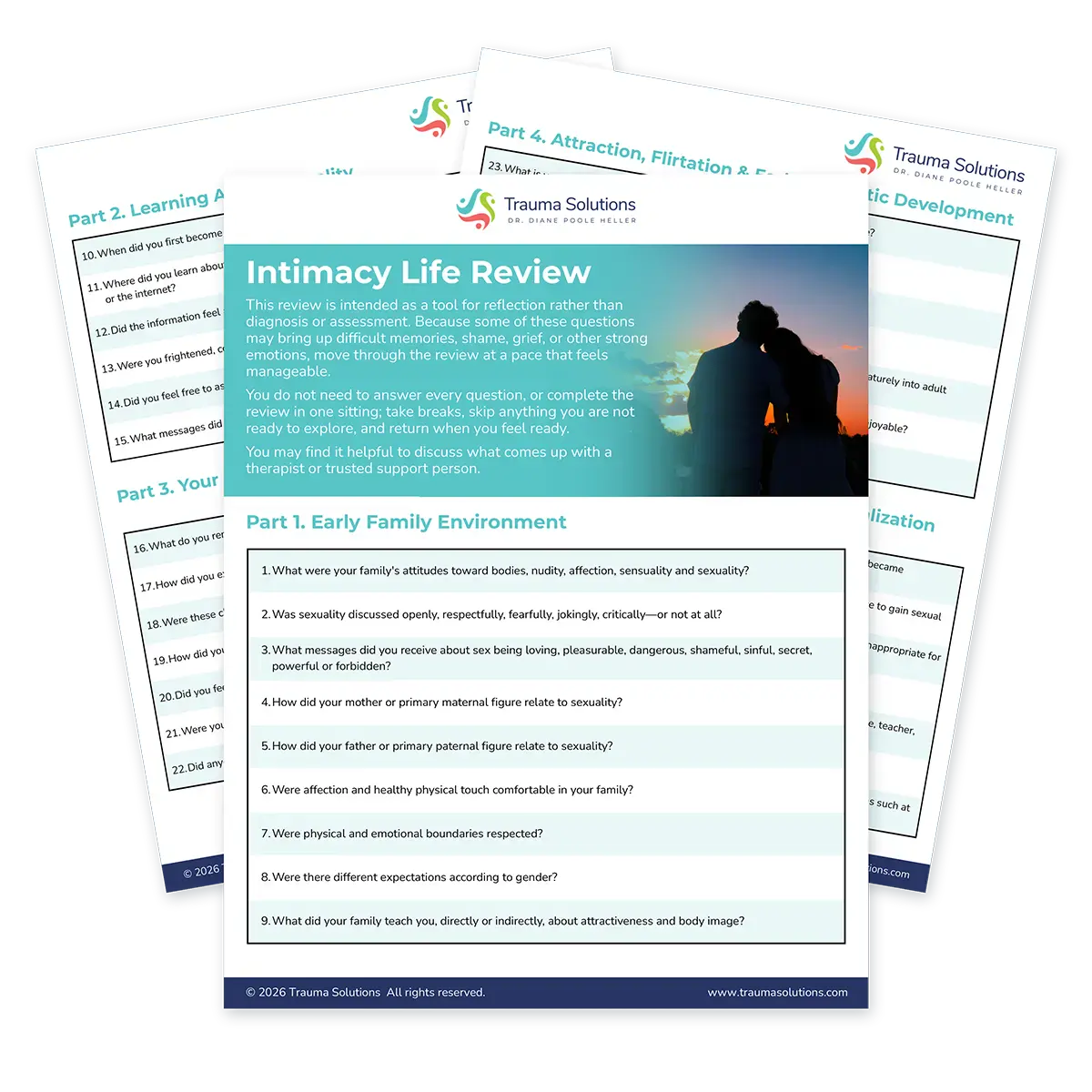
Diane’s Intimacy Life Review Handouts
Consider sexual wellbeing within the context of a client’s developmental and relational history.
Diane’s Intimacy Life Review handouts help you examine experiences and messages that may have shaped a client’s relationship with their body, sexuality, and closeness.
The handouts—ready to download and use with your clients—invite reflection on the body, relationships that influenced sexual self-image, and experiences of curiosity, autonomy, or pleasure that may have been interrupted.
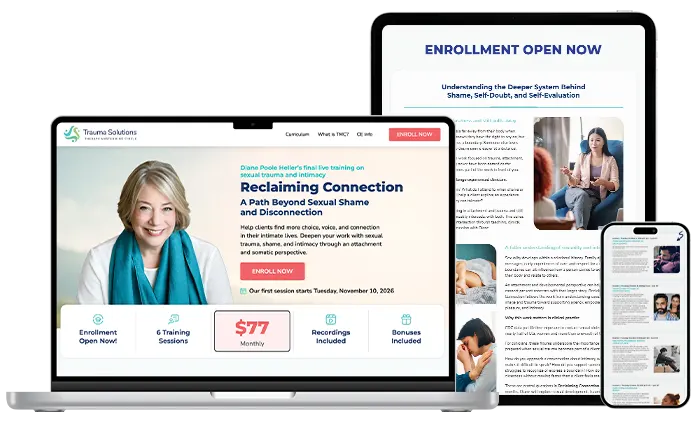
Private Course Portal with Downloadable Access to Video, Audio, and Transcripts
Every live training will be recorded. The recorded replay will be available in video, audio, and written format—so you’ll be able to access content 24/7/365 when you need it.
If you miss a training session, want to download transcripts and use them for reference and note-taking––or you want to revisit the demos for specific cases at a later date––you’ll be able to do so at your convenience.

Learn directly from leading experts in trauma training!
All for only
(Membership includes access to new topics every 6 months!)
- Six LIVE, two-hour Monthly Training Sessions with Diane Poole Heller, PhD
- Recorded Clinical Demonstrations with Debriefs and with live Q&A
- Private Course Portal with Downloadable Access to Video, Audio, Transcripts and Handouts
- Community discussion, breakout groups, and monthly prompts for practicing what you learn between sessions
- No-Risk 100% Money-Back Guarantee
Our first live call is on November 10, 2026!
Can’t attend live? All training is recorded and available in your learning portal.
**This is an annual membership––with new topics introduced every six months to support your learning.
You’re Protected by our 100% Satisfaction Guarantee
We’re confident this program will be a valuable investment in your education and clinical practice.
Try the Therapy Mastermind Circle membership 100% risk-free! You have 30 days from the start of the first class to contact our Customer Support Team for a full refund if you feel the program does not meet your needs—no questions asked.
“When we help clients feel safer in their bodies and more able to express their needs and boundaries, we support the possibility of intimacy with greater choice and less shame.”
– Dr. Diane Poole Heller
Is this training a good fit for you?
In this Therapy Mastermind Circle series, you’ll deepen your ability to:
-
Connect sexual concerns with attachment, development, and trauma
Consider how early experiences and relational history shape a client’s relationship with their body, sexual self-image, and capacity for intimacy. -
Understand sexual shame and protective responses
Recognize how withdrawal, dissociation, and disconnection during intimacy may reflect a client’s efforts to protect themselves from overwhelming experiences. -
Support greater awareness of needs and boundaries
Study approaches that help clients notice bodily responses, communicate their needs, and experience more choice about closeness and sexual connection. -
Understand the relationship between emotional closeness and sexual desire
Examine how attachment patterns can influence a client’s experience of vulnerability, autonomy, and desire within intimate relationships. -
Connect clinical observation with practical application
Learn through recorded demonstrations, Diane’s debriefs, guided exercises, and peer discussion as you consider how the material applies to your clients. -
Deepen the attachment and trauma work you already do
Bring a clearer developmental and somatic perspective to conversations about sexuality, even if you do not specialize in sex therapy.
If you want to feel more prepared when sexual concerns enter the conversation, this series provides a focused place to study, reflect, and connect the learning with your clinical work.
Continuing Education (CE) Credits
Licensed Mental Health Professionals
Do you need CE credits?
This course has been approved for 10 CE credit hours
Course Level: Beginning to advanced practice professionals
Target Audience: Licensed mental health professionals
Continuing Education Credit has been approved for the following professions:
- Psychologists
- Social Workers
- Counselors, MFTs and Addictions Professionals
Acceptance for counselors, MFTs and addictions professionals varies by state. See the state board acceptance lists in the CE details below.

*ONLY THE LIVE ONLINE SESSIONS ARE APPROVED FOR CE CREDITS.
To be eligible, professionals must attend ALL SIX sessions. Attendance will be taken to verify eligibility.
A Certificate of Completion is available to all participants at the end of the course at no additional charge upon request.
It is the participants’ responsibility to check their individual state boards to verify CE requirements for this state. For detailed information regarding CEs, please contact our Customer Support Team.
Information on Continuing Education Credit for Health Professionals

In support of improving patient care, this activity has been planned and implemented by Amedco LLC and Trauma Solutions™. Amedco LLC is jointly accredited by the Accreditation Council for Continuing Medical Education (ACCME), the Accreditation Council for Pharmacy Education (ACPE), and the American Nurses Credentialing Center (ANCC), to provide continuing education for the healthcare team.
Amedco Joint Accreditation Provider Number: 4008163
Professions in scope for this activity are listed below.

This course is co-sponsored by Amedco and Trauma Solutions. Amedco is approved by the American Psychological Association to sponsor continuing education for psychologists. Amedco maintains responsibility for this program and content.
Maximum of 10.00 hours.
State board acceptance (APA)
The following state boards accept courses from APA providers for Psychologists/Counselors: AK, AR, AZ, CA, CO, CT, DC, DE, FL, GA, HI, IA, ID, IL, IN, KS, KY, MA, ME, MN, MO, NC, ND, NH, NE, NJ, NM, NV, OH, OK*, OR, PA, RI, SC, SD, TN, TX, UT, VA, WA, WI, WY
MA: Accepts APA for all classes of psychology license; does not accept APA for licensed counselors (LMHC, LMFT, etc.) except LEP.
MD: Does not accept Jointly Accredited content.
MI: Accepts courses from APA for Psychologists. No general CE requirement for Counselors.
OK: Accepts APA credit for live, in-person activities but not for ethics and/or online courses.
The following state boards accept courses from APA providers for MFTs: AK, AR, AZ, CA, CO, CT, DE, FL, GA, IA, ID, IN, KS, MD, ME, MO, NE, NC, NH, NJ, NM, NV, OH, OK*, OR, PA, RI, SC, SD, TN, TX, UT, VA, WA, WDC, WI, WY
AL MFTs: Credits authorized by NBCC or any other state licensing agency will be accepted.
MA MFTs: Participants can self-submit courses not approved by the MAMFT board for review.
MI MFTs: There are no CE requirements for MFTs in MI.
The following state boards accept courses from APA providers for Addictions Professionals: AK, AR, CO, CT, DC, DE, GA, IA, IN, KS, LA, MD, MO, MT, NC, ND, NE, NJ, NM, NY (held outside NY ONLY), OK*, OR, SC, UT, WA, WI, WY
The following state boards accept courses from APA providers for Social Workers: AK, AR, AZ, CA, CO, DE, FL, GA, ID, IN, KY, ME, MN, MO, NE, NH, NM, OR, PA, VT, WI, WY

As a Jointly Accredited Organization, Amedco is approved to offer social work continuing education by the Association of Social Work Boards (ASWB) Approved Continuing Education (ACE) program. Organizations, not individual courses, are approved under this program. State and provincial regulatory boards have the final authority to determine whether an individual course may be accepted for continuing education credit. Amedco maintains responsibility for this course. ASWB Content Level: Intermediate.
Social workers completing this course receive up to 10.00 continuing education credits.
State board acceptance (ASWB ACE)
The following state boards accept courses offering ASWB ACE credit for Social Workers: AK, AL, AR, AZ, CA, CO, CT, DC, DE, FL, GA, HI, ID, IL, IN, IA, KS, KY, LA, ME, MD, MA, MI, MN, MS, MO, MT, NC, ND, NE, NH, NM, NJ, NV, OH, OK*, OR, PA, RI, SC, SD, TN, TX, UT, VT, VA, WA, WI, WV*, WY
OK: Accepts ASWB ACE for live, in-person activities but not for ethics and/or online courses.
WV: Accepts ASWB ACE unless activity is held live in West Virginia.
The following state boards accept courses offering ASWB ACE credit for Counselors: AK, AR, AZ, CA, CO, CT, DC, DE, FL, GA, IA, ID, IL, IN, KS, MA (LEP ONLY), MD, ME, MO, ND, NE, NM, NH, NV, OK*, OR, PA, TN, TX, UT, VA, WI, WY
MI: No CE requirement for licensed counselors.
The following state boards accept courses offering ASWB ACE credit for MFTs: AK, AR, AZ, CA, CO, FL, IA, ID, IN, KS, MD, ME, MO, NC, NE, NH, NM, NV, OK*, OR, PA, RI, TN, TX, UT, VA, WI, WY
AL MFTs: Credits authorized by NBCC or any other state licensing agency will be accepted.
MA MFTs: Participants can self-submit courses not approved by the MAMFT board for review.
MI: No CE requirement for licensed MFTs.
The following state boards accept ASWB ACE credit for Addictions Professionals: AK, CA, CO, CT, GA, IA, IN, KS, LA, MO, MT, ND, NM, NV, OK, OR, SC, WA, WI, WV, WY
Learning Objectives
By the end of this training participants will be able to:
- Explain how family, cultural, and relational messages about sexuality shape a client’s developing sexual self-image.
- Identify at least three ways sexual trauma can interrupt, distort, prematurely accelerate, or cause withdrawal from normative sexual development.
- Describe at least three ways childhood boundary violations can affect adult sexuality, intimacy, and embodied presence.
- Explain why children who experience grooming or sexual abuse may simultaneously experience affection, pleasure, fear, and danger, and how this contributes to later confusion.
- Describe the physiological sequence of defensive responses (orienting, fight, flight, freeze, and immobilization) that occurs during sexual assault.
- Explain how incomplete or thwarted defensive responses contribute to posttraumatic symptoms such as helplessness, dissociation, and collapse.
- Describe an embodied model of consent that extends beyond a cognitive yes/no decision to include interoceptive awareness of desire, reluctance, and “no.”
- Apply somatic interventions that help clients locate, trust, and express their voice and set embodied boundaries.
- Identify at least three ways emotional security and closeness can activate sexual inhibition in clients with histories of attachment disruption or sexual trauma.
- Discuss splitting and dissociation, including the “heart–genital split,” as adaptations to high levels of physiological activation.
- Identify strategies for helping clients tolerate pleasure and aliveness without triggering overwhelming physiological activation.
- Discuss approaches for reconnecting intimacy, attachment, and sexuality in support of a more integrated sexual self.
Frequently Asked Questions
How can we help you?
What is the Therapy Mastermind Circle membership program?
TMC is an annual membership program where we meet monthly to explore relevant topics, share expert learning, and develop practical skills to help you and your clients thrive. New topics are introduced every six months. You have lifetime access to the learning portal and materials for every 6-month topic you complete, including videos, demos, transcripts, worksheets, exercises and bonuses.
If you cancel your subscription to Therapy Mastermind Circle before completing the current 6-month topic, you will have 30 days—from the time you give notice of your cancellation—to download the materials for your personal use. The current membership subscription rate is $77/month, which will be applied as long as you continue your membership. If you cancel at any time and rejoin the program at a later date or topic—monthly rates may be subject to change.
Do I need to be a therapist to be in the Therapy Mastermind Circle membership?
No, you do not. While this series is designed primarily for therapists and helping professionals who work with attachment and trauma, non-therapists may also join. You do not need to specialize in sex therapy to find the material relevant.
This series includes recorded clinical demonstrations, guided experiential exercises, and optional small group discussions. Because the material addresses sexual trauma, grooming, childhood boundary violations, and shame, we encourage non-therapists who participate to have therapeutic support in place. This program provides education and is not a substitute for therapy.
The training is particularly relevant for psychologists, therapists, counselors, somatic practitioners, and other helping professionals whose clients bring concerns about sexuality and intimacy. You’ll study how developmental and relational experiences shape sexual self-image, protective responses, boundaries, and the relationship between emotional closeness and desire.
When are the live classes?
We meet online on Tuesdays from 1–3 pm ET / 12–2 pm CT / 11 am–1 pm MT / 10 am–12 pm PT.
Month 1 — November 10, 2026 · Development of a Sexual Self-Image
Month 2 — December 1, 2026 · Grooming, Incest, and Boundary Violations
Month 3 — January 12, 2027 · Sexual Assault: Trauma, Power, and Helplessness
Month 4 — February 23, 2027 · Empowering Boundaries and Embodiment
Month 5 — March 9, 2027 · The Love Lust Split
Month 6 — April 20, 2027 · Reclaiming Intimacy and Aliveness
Are the class sessions live or pre-recorded?
What if I can’t make it to the live calls?
We encourage you to join each session live, but if you can’t attend, video and audio recordings, transcripts, and course resources will be available in your learning portal so you can catch up or revisit the teaching, including Diane’s Q&A and debriefs of the recorded clinical demonstrations.
You can download and keep the session recordings, transcripts, and supporting materials in your professional reference library. To protect client privacy, clinical demonstration videos are available for viewing in the portal only and may not be downloaded.
You can also submit questions through Kajabi, our learning portal, outside the live sessions. Use this space to ask questions, share reflections, and continue the discussion with your colleagues.
Are the clinical demonstrations live?
The planned demonstrations are recorded clinical sessions. Diane will teach live, debrief the material, and answer questions. Optional breakout groups after each session offer time for peer discussion.
How many CE credits can I earn for this course?
Only the LIVE, ONLINE sessions for this course have been approved for up to 10 CE credit hours. Eligible psychologists, social workers, counselors, MFTs and addictions professionals (where accepted by their state board) may purchase CE credits for an additional $89 via our website.
CE credits must be purchased by the beginning of the last live session on April 20, 2027. Attendance will be taken to verify eligibility.
Upon completion of the program, you will receive an activity evaluation link, which you must complete within 60 days after the last session, by Saturday, June 19, 2027. After completing the evaluation, you can immediately print your certificate or statement of credit.
A Certificate of Completion is also available to all students upon request at the end of the course, at no additional charge.
It is each participant’s responsibility to confirm that their licensing board accepts these CE credits. For detailed information about CEs or to request a Certificate of Completion, please contact our Customer Support Team.
Are there any discounts or scholarships available for this course?
We do offer a limited number of partial scholarships for students who attend an accredited university. Reduced enrollment rates are also available for those with limited resources in countries defined as low and lower middle income by the World Bank. Please contact us for more information.
I’m having trouble completing the purchase. How can I get support?
If you have additional questions or need technical support, please contact our Customer Support Team for help.
What is the refund policy for this 6-month membership topic?
Ready to join us?
Learn with Diane as you explore the roots of sexual shame and disconnection—and ways to support greater agency, embodied boundaries, and intimacy.
All for only
(Membership includes access to new topics every 6 months!)
- Six LIVE, two-hour Monthly Training Sessions with Diane Poole Heller, PhD
- Recorded Clinical Demonstrations with Debriefs and with live Q&A
- Private Course Portal with Downloadable Access to Video, Audio, Transcripts and Handouts
- Community discussion, breakout groups, and monthly prompts for practicing what you learn between sessions
- No-Risk 100% Money-Back Guarantee
Our first live call is on November 10, 2026!
Can’t attend live? All training is recorded and available in your learning portal.
**This is an annual membership––with new topics introduced every six months to support your learning.
You’re Protected by our 100% Satisfaction Guarantee
We’re confident this program will be a valuable investment in your education and clinical practice.
Try the Therapy Mastermind Circle membership 100% risk-free! You have 30 days from the start of the first class to contact our Customer Support Team for a full refund if you feel the program does not meet your needs—no questions asked.
This is an annual membership program with rotating 6-month topics, and you have lifetime access to the learning portal and materials for every completed topic (including videos, transcripts, worksheets, exercises, and bonuses).
If you wish to cancel your subscription at any time after the 30 days, you must provide 30 days’ written notice of cancellation. If you decide to cancel before completing the current 6-month topic, you will have 30 days from your cancellation notice to download the materials for personal use.
Please note that if you cancel your membership subscription and choose to rejoin later, the monthly rates may change.
For those with financial needs, a limited number of partial scholarships are available. Please contact our Customer Support Team for further information.